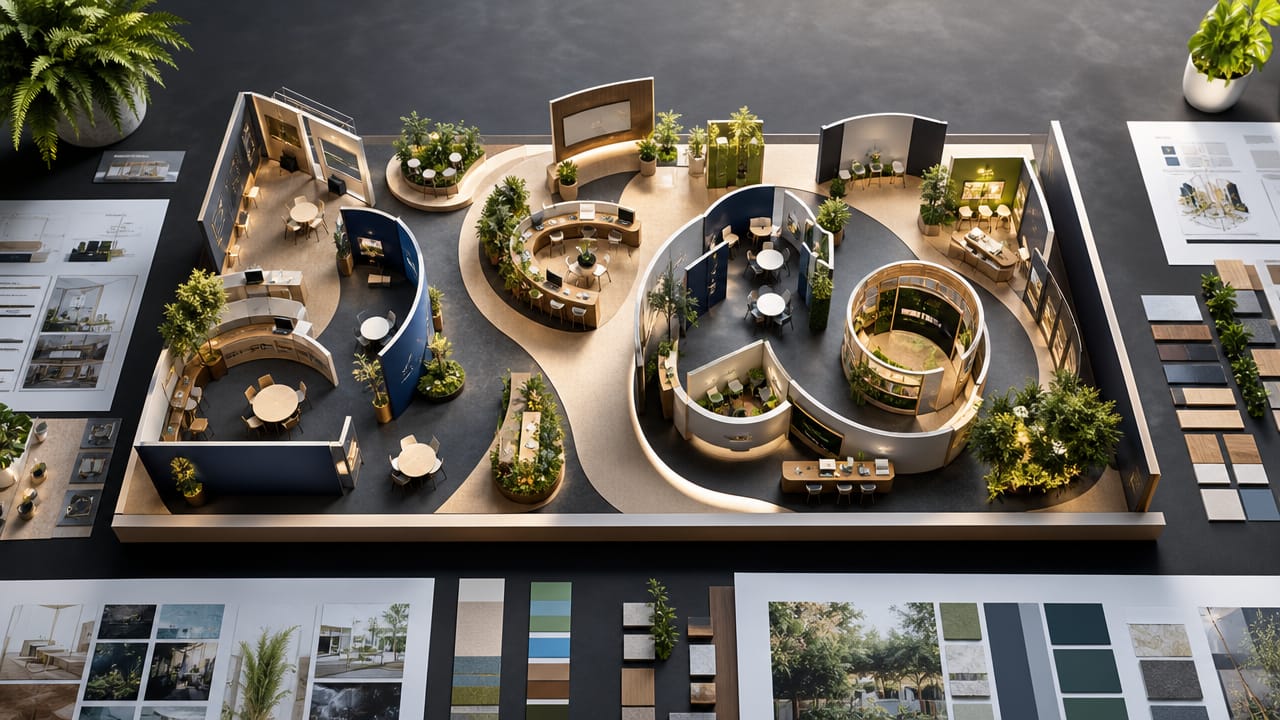



Layout is one of the most powerful drivers of visitor engagement on an exhibition stand. When your space is thoughtfully planned, people are more likely to enter, stay longer and progress from a quick glance to a quality conversation. In busy Australian venues such as ICC Sydney or Melbourne Convention and Exhibition Centre, strong Exhibition Stand Design can help your brand stand out, support staff performance and turn casual interest into qualified leads.
A clear layout reduces uncertainty for visitors, signalling where to walk, what to look at first and where to speak with your team. Studies by major trade show associations consistently link good circulation with higher dwell time and improved lead quality. In practice, this means exhibition booth design should prioritise how people move, not just how the stand looks in a 3D render. Thinking about behaviour first ensures the space works in real-world show conditions.
Three concepts underpin most effective layouts: flow, zoning and visual hierarchy. Flow focuses on how easily visitors can enter, circulate and exit without bottlenecks, which is essential for strong visitor flow exhibition stands in peak periods. Zoning involves defining areas for welcome, demonstrations, meetings and storage, so each activity has an appropriate space. Visual hierarchy ensures your most important messages and products are visible from the aisle and guide visitors naturally deeper into the stand.
Open frontages or open plan exhibition booth layouts usually perform well because they remove physical and psychological barriers to entry. Avoid placing high counters or furniture on the stand edge, as staff may unintentionally block access. Instead, position your boldest feature or hero product at the perimeter and move interactive elements slightly inside to encourage exploration. Complement this with branded exhibition stand graphics that are legible from a distance and aligned with your core message.
When planning trade show stand layout ideas, consider how different visitor types will use the space. Quick browsers may only spend a minute at the front, so ensure key information is visible immediately. Decision-makers often need quieter areas for discussion, which might be semi-enclosed but still connected to the main stand. For product-focused custom stands, leave adequate room around hero products so people can gather, watch a demonstration and speak with your team without blocking circulation.
Local context also matters for australian exhibition stand design, particularly regarding regulations, accessibility and venue services. Allow space for prams and wheelchairs, keep cabling safely managed, and plan storage so it does not spill into public areas. If you work with custom exhibition stands, request a simple visitor journey map from first glance to lead capture. Supporting elements such as immersive exhibition stand lighting can then be layered in to highlight zones rather than compete with them.
Even a small footprint stand design can feel generous if you simplify furniture, keep lines of sight open and focus on one or two clear objectives. Early in planning, clarify whether your priority is meetings, demonstrations, sampling or brand awareness, then let those priorities drive the layout. Reviewing your Exhibition Stand Design after each event—looking at dwell time, meeting quality and staff feedback—will help you refine your approach. Before your next show, speak with a specialist or ask your stand builder to walk you through layout options so you can make confident, evidence-based decisions.
Input your search keywords and press Enter.