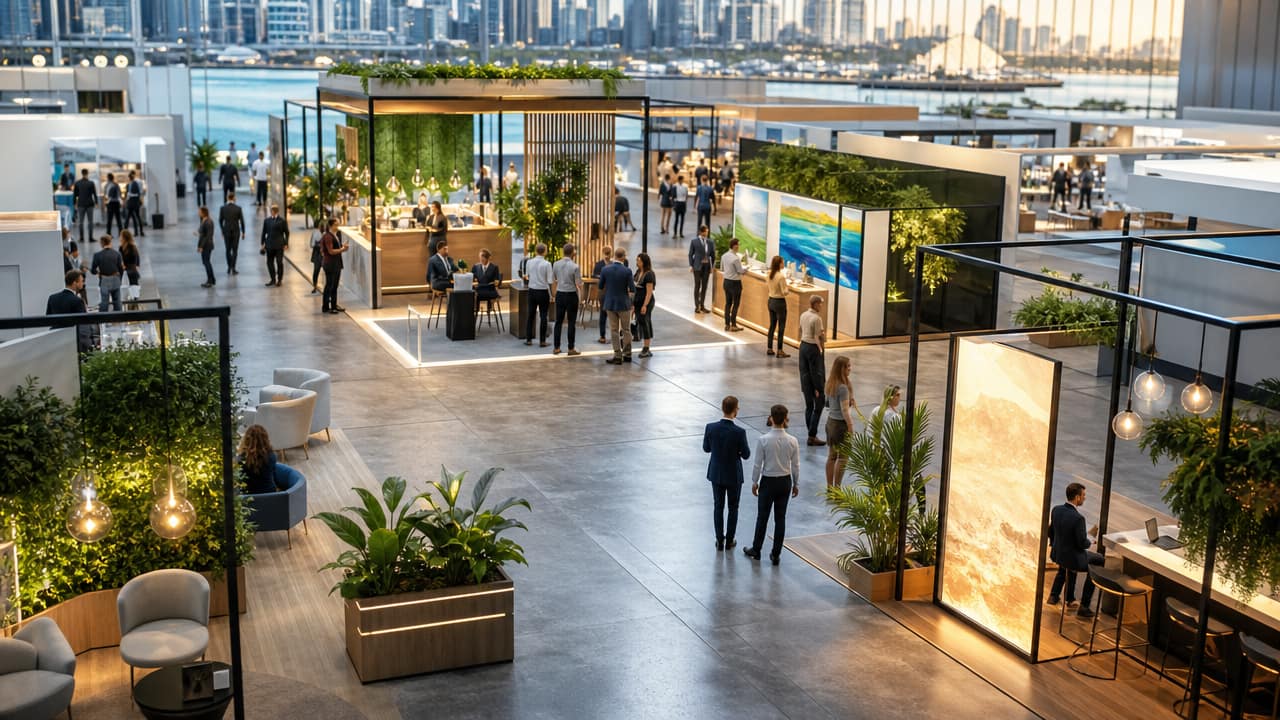



Multi-functional stand areas are rapidly becoming a competitive advantage for exhibitors across Australia. As venue costs rise and marketing budgets tighten, brands are reassessing how every square metre performs. Thoughtful multi-functional stand layouts allow teams to integrate display, engagement and meeting functions into one cohesive environment, elevating both impact and efficiency. When approached strategically, these spaces move beyond aesthetics to become a physical expression of marketing intent and a powerful testbed for ongoing optimisation.
“In a constrained floorplan, every square metre must justify its existence in terms of commercial outcomes, not just visual appeal.”
Multi-functional stand areas respond directly to shorter visitor attention spans and the demand for measurable ROI. A single footprint can host live demos, discovery conversations and hospitality without feeling congested. This creates more touchpoints per hour and supports exhibition booth design strategies focused on quality engagement rather than sheer volume. For marketers, the key is mapping priority interactions first, then shaping zones and circulation paths to support those behaviours intuitively.
Australian exhibitors are under pressure to deliver flagship experiences in modest spaces, especially in capital city venues. Multi-functional stand layouts allow a theatre-style demo area to convert into a lounge or workshop space within minutes using movable furniture and lighting presets. This agility reduces the need for larger footprints and lowers build, transport and storage costs. Over multiple shows, modular custom exhibition stands built on reusable components offer better lifecycle value than one-off builds.

Leading teams treat Exhibition Stand Design as experience choreography rather than decoration. They combine flexible product display zones, integrated meeting pod areas and hospitality corners to guide visitors from initial curiosity to qualified conversation. Zoned exhibition stand design supports clearer storytelling, while multi-purpose branding walls and open-plan demo stand concepts maintain visibility from the aisle. Importantly, adaptive exhibition booth interiors can be reconfigured across different shows, sectors and states without diluting brand consistency.
To capture emerging opportunities, marketers should review visitor data, dwell-time patterns and sales feedback, then translate those insights into sharper exhibition stand ideas and multi-functional stand layouts. Prioritise visitor flow focused stand design, technology that supports live content pivots, and scalable structures ready for new product launches. By aligning stand architecture with commercial outcomes, you turn each event into a strategic asset rather than a one-off appearance. To explore how multi-functional thinking could reshape your next program, speak with an expert team and pressure-test your current approach before the next show cycle.
Input your search keywords and press Enter.