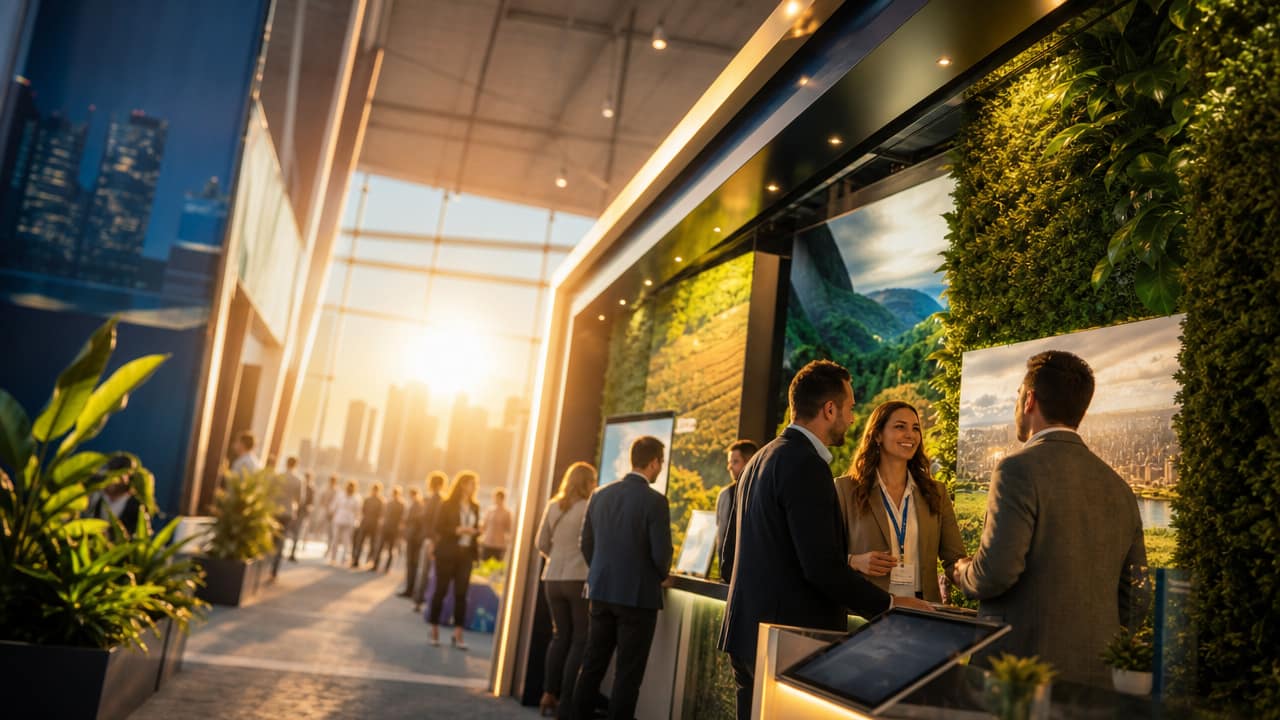



Creating eye-catching booth signage that attracts visitors is often treated as an afterthought in Australian expos, yet it can quietly determine whether your stand thrives or disappears into the background. When australian trade show signage fails, even strong products and well-trained staff struggle to cut through the visual clutter of a busy floor. The result is fewer conversations, weaker exhibition lead generation, and a disappointing return on substantial event spend.
Many exhibitors assume that a large logo and a colourful backdrop are enough to drive traffic, but this overlooks how attendees actually move and make decisions. Visitors scan aisles quickly, judging stands in seconds based on clarity, relevance, and visual impact. Dense copy, low-contrast colours, and fussy trade show booth graphics become hard to decode at a distance. In this environment, even the most compelling offer is ignored if visitors cannot grasp what you do within a quick glance.
In Trade Show Marketing across Australia, every square metre of floor space is a paid-for opportunity to start a conversation. Travel, logistics, and custom stand builds quickly push budgets into five-figure territory, so poor signage becomes a hidden cost multiplier. When your messaging fails to convert passing traffic into engaged prospects, your stand effectively becomes a static billboard. Over multiple events, this compounds into missed partnerships, slower pipelines, and weaker trade show promotion outcomes than your competitors.

Typical booth signage ideas fall down because they’re built from internal assumptions rather than visitor behaviour. Key messages are often placed too low, disappearing behind crowds, or fragmented across multiple panels so no single statement stands out. Inconsistent fonts, random colour palettes, and mismatched imagery dilute exhibition branding tips you may follow elsewhere. Without a defined hierarchy, visitors don’t know where to look first, making it harder for them to decide whether your offer is relevant.
These warning signs indicate that your visuals are not communicating value quickly enough to passing decision-makers. Effective event signage best practices focus on legibility at distance, simple benefit-led headlines, and visitor-focused booth messaging aligned with real buying pain points. When ignored, you rely on luck rather than design to capture attention. Over time, this limits the impact of your exhibition marketing, no matter how strong your product or sales team might be.
Rethinking your approach means treating signage as a conversion tool, not decoration. Prioritise one clear benefit statement, a visible brand mark, and a direct next step to support conversion-driven booth visuals. Supporting elements like lighting, motion, and concise attention-grabbing display signage should guide the eye rather than overwhelm it. For brands serious about maximising exhibition impact, collaborating with specialists in exhibition marketing and Trade Show Marketing can transform underperforming signage into a strategic driver of results.
If your current setup matches any of these issues, now is the time to reassess before your next event. Review photos of past stands, check how readable your messages are from the aisle, and benchmark against event signage best practices from high-performing exhibitors. Then, consider speaking with an expert to refine your trade show booth graphics and messaging so every show becomes a stronger platform for growth.
Input your search keywords and press Enter.